
Arenac County Parole and Probation
Parole and probation both permit a person to live outside a secure facility under rules, but they begin in different ways. The Michigan Parole Board is the sole paroling authority for felony offenders committed to the Michigan Department of Corrections. A parolee has left the prison phase of a sentence yet remains in MDOC legal custody. Probation is imposed by a court. It may follow a short jail term, or the judge may order probation without a state-prison term at all.
That split determines which Arenac County post-release supervision record to consult. OTIS, the MDOC Offender Tracking Information System, covers people on MDOC parole and state-supervised probation. The Arenac court register can show the probation order, its conditions, later violations, and a termination or discharge entry. A person who only served time at Arenac County Jail does not enter OTIS merely because of that stay.
| Question | Parole | Probation |
|---|---|---|
| Who orders it? | Michigan Parole Board after an MDOC prison sentence | The sentencing court |
| What came before? | State-prison custody | A court sentence, with or without jail |
| Main public check | OTIS status, date paroled, and supervision location | OTIS when MDOC supervises it, plus the local court register |
| When does it end? | Discharge from MDOC jurisdiction for that sentence | Court termination or discharge under the controlling order |
Verify Arenac County Post-Release Supervision
Start with the legal source that matches the sentence. OTIS can distinguish an MDOC prisoner, parolee, probationer, absconder, and recent discharge. It does not cover county-jail-only custody or every locally administered court matter. MiCOURT and the Arenac court offices provide the court side of the record. Use both when the path is unclear.
- Open the MDOC OTIS overview and enter the live search. Use the MDOC number when known.
- Set offender status to all when searching for a discharge. A narrow status choice can hide the record sought.
- Compare the name, MDOC number, descriptors, sentence data, and supervision location before relying on a match.
- Read the exact code. PAROLE and PROB mean active MDOC field supervision. DISCHRG means MDOC jurisdiction ended for that sentence, but its reason still needs review.
- Follow OTIS's location link or use the current MDOC office directory to confirm the assigned office.
- Search the Arenac MiCOURT display for a probation order, later violation, or discharge entry.
A court order establishes the authority for probation. OTIS shows the state field-supervision record where MDOC is involved. Neither one, by itself, proves the exact moment a person left Arenac County Jail. For that custody event, use the Sheriff’s release record path described on the Arenac County released-inmate search.
When no MDOC number is known, OTIS accepts a name and added descriptors. The official guidance permits a wildcard after three initial letters of a last name and filters for gender, approximate age, race, status, and exact scars, marks, or tattoos. Search with status set to all for a discharged person. Open the offender number only after the identifying details align, then follow the location link for the supervising office.
Arenac County Supervision Office
The current MDOC parole and probation directory places Arenac County in Field Operations Administration Region 5. The local listing is more useful than a general regional address when OTIS points to Standish. Assignments and office details can change, so check the live directory before a visit or call.
Arenac County Parole/Probation Office
Courthouse
120 N. Grove Street
Standish, MI 48658
989-846-9720
The office can address lawful questions about reporting and the supervision record. It is not the custodian for an Arenac County Jail booking photo or release log. It may also lack control over a District Court probation matter administered through the court. Begin with the authority named in the judgment and the status shown in OTIS.
The directory image below comes from the official MDOC office-directory source.
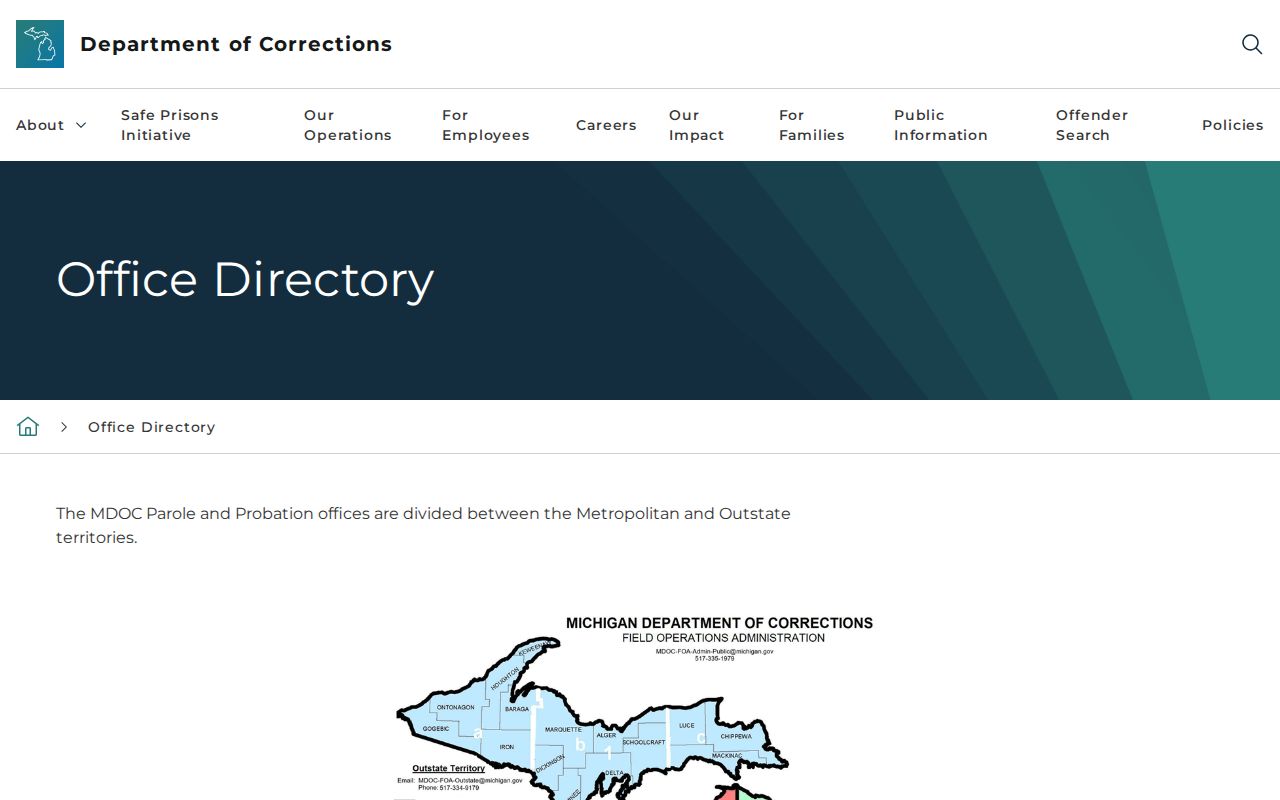
Its Region 5 listing supplies the current route from an Arenac County supervision record to the office responsible for the case.
Arenac Supervision Status Codes
OTIS status codes need literal, careful reading. PRISON normally reflects an institutional MDOC status, though MDOC says the category can include a person temporarily on writ elsewhere or held for another government. PAROLE is the clearest sign that the institutional phase ended, but the person still serves the sentence under MDOC custody. PROB identifies an MDOC-supervised circuit-court probationer and does not prove a prior prison release.
ABSCOND1 denotes a parole absconder; ABSCOND2 denotes a probation absconder. An absconder failed to remain available as required. The label is not a known jail location, a new release event, or permission to seek the person. MDOC directs information to local law enforcement and lists an Absconder/Escapee Tip Line at 517-755-0855. Do not approach or publish an address.
DISCHRG is the strongest sign that MDOC supervision ended for that sentence. The reason matters because MDOC includes successful completion, reaching the maximum without parole, and death before completion among possible paths. UNKNOWN can reflect old conversion data or later court action and cannot be mapped to custody or release without another source.
How Arenac Supervision Ends
A parole date and a discharge date answer different questions. “Date Paroled” records when a person left prison or camp, or when parole status was conferred in another setting described by MDOC. The maximum discharge date is the possible endpoint of the controlling sentence. Actual discharge ends MDOC jurisdiction for that term. Another sentence, warrant, or government custodian can still exist, so no single label should be expanded beyond what it says.
OTIS keeps public information for three years after discharge from supervision. That clock does not necessarily begin when the person walked out of prison. A parolee may remain visible during supervision and for the additional public period after discharge. A missing older record can be a normal result of the display window or a qualifying set-aside. For a durable record, request the public portions of the discharge certificate, parole release record, Basic Information Sheet, and existing records identifying the actual parole and discharge dates from MDOC.
Arenac Parole Grant Processing
A favorable Parole Board decision is not proof that the prison gate has opened. MDOC says routine release processing includes at least a 28-day interval between the decision and physical release. The Parole Release Unit records the decision, proposed parole date, term, and special conditions. Staff must also coordinate a suitable placement and send required notices.
A case may be deferred while placement or treatment planning continues. Misconduct or new adverse information can suspend a positive result before release. After release, a violation can lead to revocation and return. The terms granted, deferred, denied, suspended, and revoked therefore describe separate steps. The state’s public-hearing calendar also covers only selected Lifer Law, commutation, and pardon hearings, not every routine parole interview or person-level decision.
MDOC describes state-prison parole departures as commonly processed early in the morning, with departure at or shortly after 8 a.m., but tells readers to call the facility records office for the actual date and time. That statewide prison practice is not an Arenac County Jail release schedule. “Paroled in custody” is another key exception: parole status can begin while another county, state, or federal custodian still holds the person.
Arenac County Reentry Coordination
The Arenac Sheriff page identifies a regional Community Corrections Advisory Board layer and historically lists meetings at the Ogemaw County Courthouse. The dates shown are from 2021. They demonstrate regional coordination, but they are not reliable proof of a current meeting, program opening, or assigned case contact.
Current post-release questions should instead follow the live MDOC Reentry Services channel and Region 5 office directory. Reentry services work on transition needs, while the supervision office manages reporting and conditions. The Parole Board decides parole. Keeping those roles separate prevents an old local meeting notice from being mistaken for active Arenac County post-release supervision instructions.
MI-VINE is another separate layer. It can provide custody notifications for participating county jails and general MDOC release notice, but it does not replace the supervision order or OTIS status. State material did not provide a current participation list expressly naming Arenac County Jail. Verify that coverage in VINELink or by phone before relying on an alert.
The Michigan Public Sex Offender Registry is narrower still. It applies only to people legally required to register and can display status, photo, address, and other statutory fields. “Active,” “Incarcerated,” and “Absconder” have distinct meanings there. The registry’s Track Offender tool follows registry-information changes, not every parole, probation, jail, or VINE event.
For an official record beyond OTIS, MDOC accepts FOIA requests through its coordinator at P.O. Box 30003, Lansing, MI 48909, MDOC-FOIA@michigan.gov, or 517-335-4194. A focused request may seek public portions of a discharge certificate, parole release record, Basic Information Sheet, and existing records with actual parole and discharge dates. Ask for named records, not an opinion about the person.
A local court record can remain important after MDOC supervision appears to end. The 81st District Court handles Arenac misdemeanors, felony arraignments and preliminary examinations, and felony bail. The 23rd Circuit Court handles felony merits and sentencing. Review the proper register for the judgment, probation terms, violation entries, and a later termination order. A court entry documents legal action, while the named supervision office documents its own field status.